
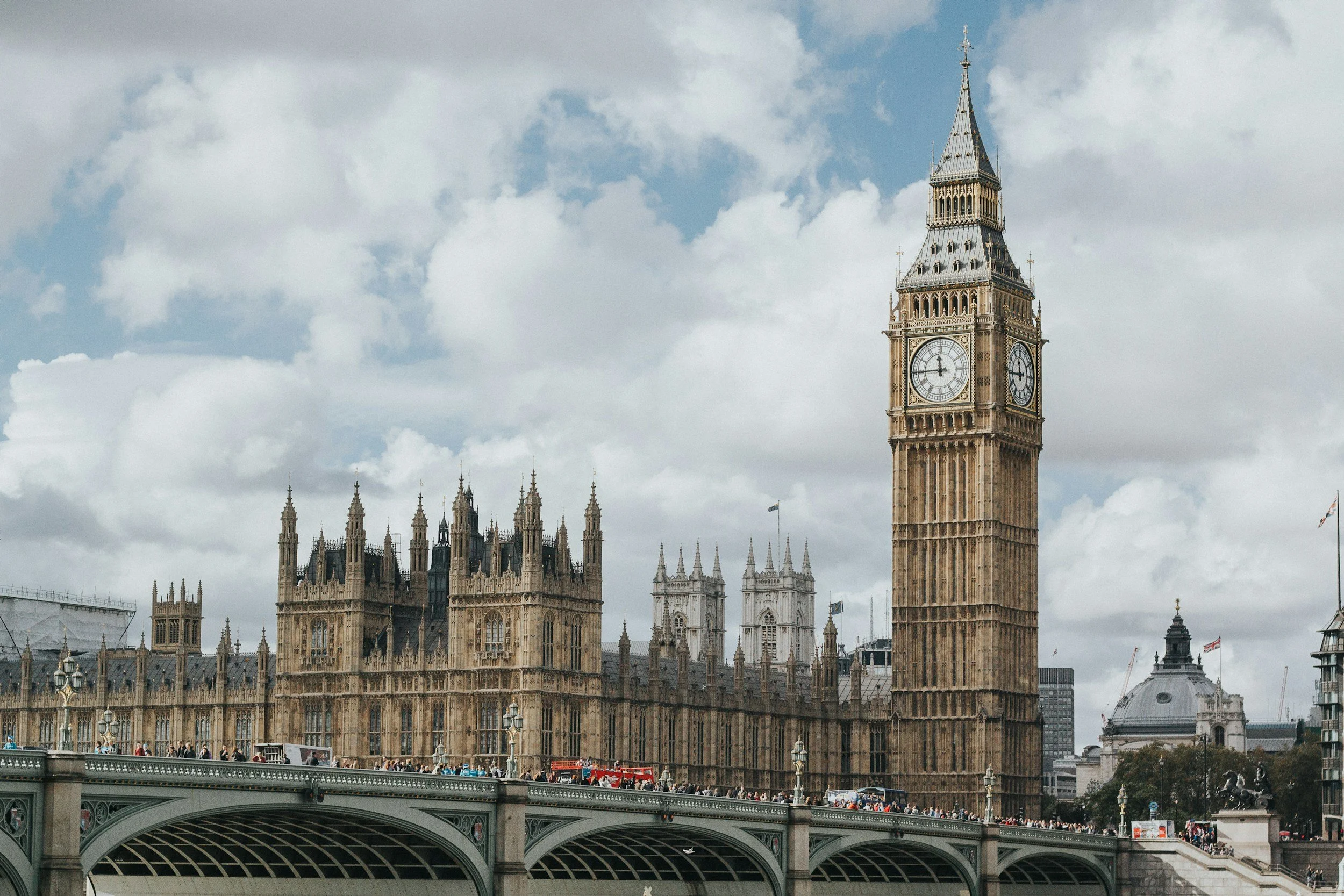
The UK Parliament is the supreme legislative body of the United Kingdom, made up of the House of Commons and the House of Lords. Unlike most Model United Nations committees, where delegates represent countries pursuing national interests, the UK Parliament committee asks delegates to step into the role of Members of Parliament, incorporating party politics into debating national issues.
At GlobalVoices 2026, UK Parliament delegates will turn to two pressing questions in contemporary British politics. The first is the biggest fiscal issue that politicians debate daily: how to reduce the national debt while maintaining the public services that keep Britian running. The second looks to the future: how Parliament should respond to artificial intelligence’s growing role in creative industries and the impacts which it could have on copyright, livelihood and authorship.
The Past
Parliament's origins lie in the medieval councils that English monarchs summoned to raise taxes and seek advice. The 1215 Magna Carta first established that the king could not levy taxes without consultation, and Simon de Montfort's Parliament of 1265 was the first to include representatives of towns alongside the nobility. Edward I's Model Parliament of 1295, which brought together lords, clergy, knights, and burgesses, is often cited as the foundation of the representative system that follows today. By the mid-fourteenth century, Parliament had split into two houses, the Commons and the Lords, a structure that has endured for nearly seven centuries.
The Bill of Rights of 1689, passed after the Glorious Revolution, was decisive. It established that Parliament, not the monarch, held sovereign authority over taxation and law. The centuries that followed saw that authority gradually democratised. The Reform Acts of the nineteenth century widened the franchise, the Parliament Act of 1911 curtailed the Lords' power to block legislation passed by the elected Commons, and women won the vote in stages between 1918 and 1928.
The Present
Today, Parliament's work is split between two chambers with different mandates. The House of Commons, elected by the public, is where government is formed and where the Prime Minister and Cabinet are held to account through mechanisms like Prime Minister's Questions and select committee hearings. The House of Lords, made up of appointed peers, scrutinises and amends legislation but cannot ultimately block the will of the elected chamber.
Much of Parliament's current business is shaped by economic pressure. Debt accumulated through the pandemic, an ageing population, and rising NHS and social care costs have left successive governments searching for ways to balance the books without cutting the services voters rely on. At the same time, Parliament is grappling with a newer problem: how to regulate artificial intelligence as it reshapes music, writing, art, and design, often without the consent of the people whose work trained it. Committees and government consultations have had to respond to questions that simply did not exist for previous generations of MPs.
The Future
Both topics before the committee point to a Parliament adapting old institutions to new pressures. On the national debt, MPs must find a way through competing demands: protecting the NHS and welfare state, maintaining investment in infrastructure and defence, and reassuring markets that Britain's finances are under control, all without provoking the kind of public backlash that has ended governments before.
On artificial intelligence, Parliament must decide how far creative work deserves legal protection in an age where machines can generate music, prose, and images in seconds, and what that means for an industry that contributes billions to the British economy and employs hundreds of thousands of people.
For delegates, the UK Parliament committee offers a chance to debate not foreign policy, but the kind of decisions that shape everyday life at home: taxation, spending, and the rules that will govern an AI-driven creative economy. The strongest contributions will be those that understand both the economics and the politics, recognising that in Westminster, as much as in any international forum, the hardest part of governing is building a majority willing to support it.